Atoms might be invisible to the naked eye, but they make up everything we see, touch, and feel.
Imagine tiny particles, much too small to see, that come together to form everything in the universe.
A miniature solar system
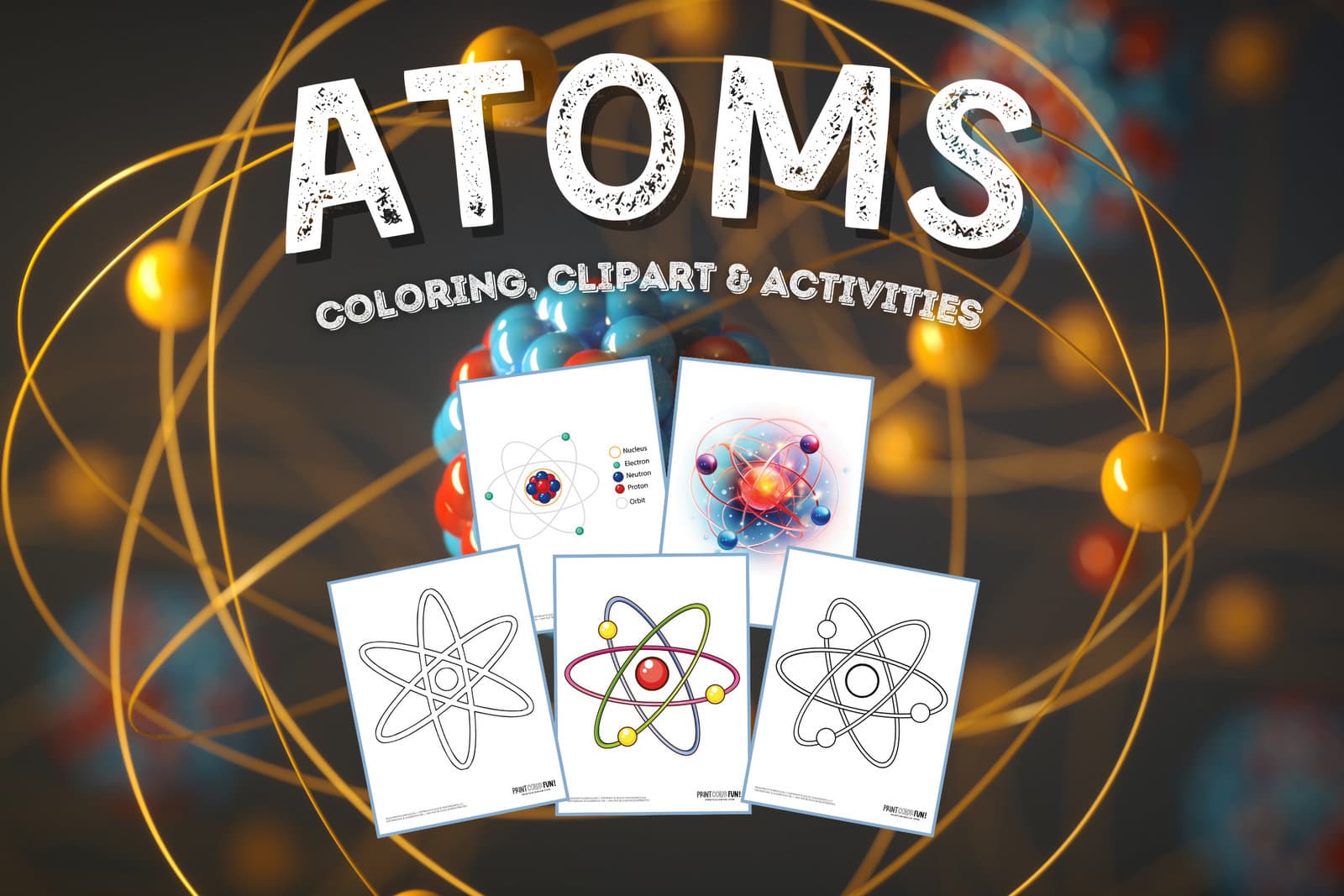
An atom consists of a nucleus, which houses protons and neutrons, with electrons buzzing around it, much like planets orbit the sun.
You could say an atom is like a miniature solar system!
The nucleus is like the sun, central and holding everything together, while the electrons are like planets, each following its own path around the nucleus.
The building blocks of matter
Atoms join together to form molecules, which are like building blocks for all matter.
Water, for example, is made when two hydrogen atoms join with one oxygen atom.
VIDEO: “How To Draw An Atom”
10 fun facts about atoms
Every human is made up of around 7 octillion atoms.
Oxygen is the most abundant element in the human body by mass.
Helium atoms never bond with other atoms to form molecules.
A single teaspoon of water contains more atoms than there are teaspoons of water in the Atlantic Ocean.
Atoms are 99.9999999% empty space.
If an atom were the size of a football stadium, its nucleus would be the size of a pea.
Gold atoms can be beaten into sheets so thin that they become semi-transparent.
Hydrogen atoms in your body are as old as the universe, formed in the Big Bang.
Atoms can be split to release a tremendous amount of energy, which is the principle behind nuclear power.
The only place in the universe where atoms at absolute zero (the coldest possible temperature) naturally exist is in space.
Craft ideas
Let’s make learning about atoms as fun as possible with these craft ideas!
Atom string art: Create an atom design on a wooden board using nails and string to represent electron paths around the nucleus.
Periodic table bookmark: Design bookmarks with atom clipart, each highlighting a different element from the periodic table.
Atom model cupcakes: Decorate cupcakes to look like atoms, using candies to represent protons, neutrons, and electrons.
3D atom suncatchers: Use transparent beads and wire to craft atom models that catch the sunlight beautifully.
Atom puzzle game: Cut atom shapes out of cardstock, and on each piece, write facts about different atoms for a fun and educational puzzle game.
Learning activities
Engage your kids with these learning activities to deepen their understanding of atoms and science.
Atom memory match: Create a memory game using cards with atom drawings and their corresponding element names.
Edible atom models: Use marshmallows and toothpicks to build edible atom models, introducing concepts of atomic structure deliciously.
Atom-themed scavenger hunt: Hide atom clipart around the house and have kids find them, each discovery teaching about a different element.
DIY atom playdough: Craft atoms from playdough, with different colors representing protons, neutrons, and electrons.
Interactive periodic table: Design a wall chart of the periodic table where kids can attach and remove atom clipart, learning about each element’s properties.
Atom drawing & clipart
Books about atoms
Reading books about atoms can be a great way to complement these activities and deepen your child’s understanding.
Look for titles that are engaging and age-appropriate, with plenty of illustrations to spark imagination and curiosity.